Category Archives: Electronics Recycling Tips

Battery Recycling in 2026: Why It Is Becoming a Bigger Safety Issue

A pile of various batteries, smartphones, tablets, and power banks—ready for battery recycling—scattered on a wooden table in a bright, modern kitchen.

As new devices come out and built-in batteries become bigger, stronger, and more common, it is increasingly important to understand what happens when those devices reach the end of their useful life. That is why battery recycling is worth revisiting in 2026. Batteries are no longer just something people find in a junk drawer. They…

The Connection: Electronics Recycling & Critical Minerals

Close-up of colorful capacitors and copper coils on a circuit board, highlighting intricate electronic components—essential for electronics recycling—and featuring rows of blue, yellow, and brown elements with transparent blue connectors.

Electronics recycling is often a service simply connected to the idea of recycling responsibly instead of adding to a landfill. But, as data is increasingly showing, it’s not the only important aspect of recycling e-waste.  When electronics are recycled responsibly, valuable materials can be recovered and returned to the supply chain. The U.S. EPA explains…

End-of-School-Year Tech Cleanout Guide for Schools

A stack of tablets and laptops, a pile of calculators, headphones, a computer mouse, and charging cables on a classroom desk—perfect candidates for electronics recycling for schools—with empty desks and chairs in the background.

End of year electronics recycling for schools can feel quite overwhelming, but it doesn’t have to be complicated. It just needs to be organized. If your school already started planning, this is the next step: turn that plan into a simple week-of checklist so old electronics are sorted, data-bearing devices are handled carefully, and pickup…

Electronics Recycling for Schools: March Prep Before End-of-Year Chaos

A laptop displaying code sits on a desk with notebooks and pens in a classroom. Other laptops and desks are visible, highlighting the need for electronics recycling for schools, alongside a chalkboard and posters on the walls.

Electronics recycling for schools is easy to put off until the end of the year, when the carts are full, the storage room is jammed, and everyone’s trying to finish testing season at the same time. Spring is the calmer window where a little planning can save a lot of stress later, and it can…

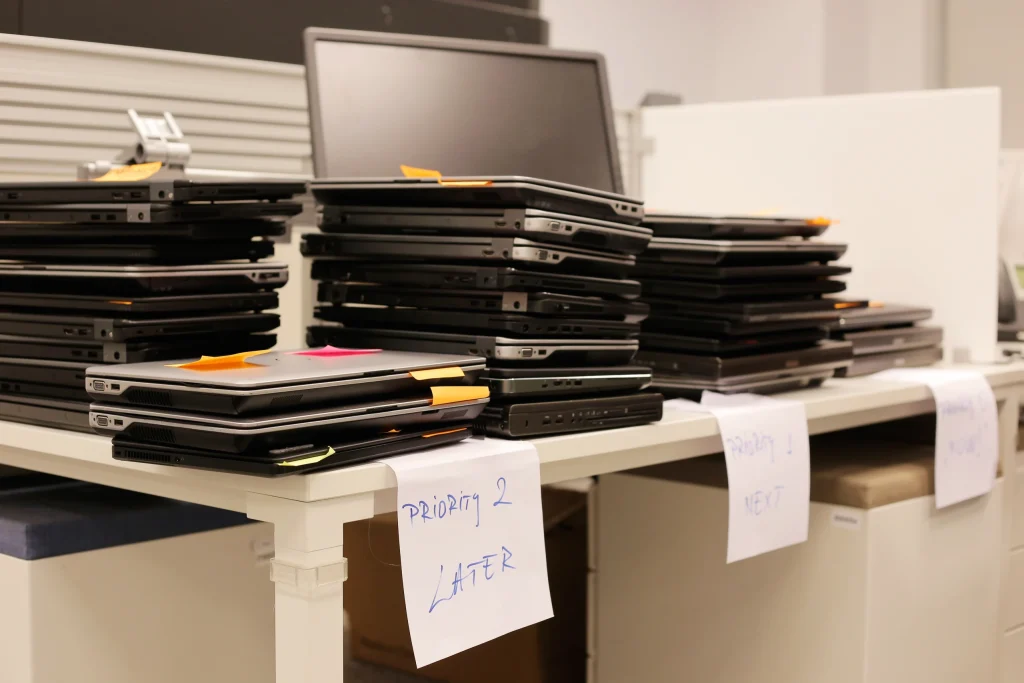
The Checkout Tech Pileup: A Practical Electronic Recycling Guide for Restaurants and Small Businesses

Several stacks of closed laptops with colored sticky notes are placed on a white table, resembling the organized system of orders in a restaurant. Handwritten labels under the stacks read “priority 2 Later,” “priority 1 Next,” and “Ready.”.

Ever open a drawer at work and find a little tech museum? A couple of old tablets, a printer cable that definitely does not match anything you still own, maybe a monitor you swear you were going to “deal with later.” It’s not trash, but it’s not useful anymore either, so it just lives there….

2026 Updates: Repair First and Electronic Recycling Done Right

A close-up of a person soldering wires onto a smartphone circuit board with a soldering iron, illustrating the right to repair. Various tools and materials are visible in the background.

In 2026, policy updates are a big priority for us, because they influence what responsible handling actually looks like day to day. Electronic recycling fits into that story, right alongside repair access and better end-of-life planning. These updates are right in line with what we care about at Omega ECycles, keeping useful items in service…

Malaysia’s E-Waste Import Ban: Why “Where It Goes” Matters

A pile of assorted electronic circuit boards and components, showing various colors, chips, and traces, stacked together in a chaotic arrangement of e-waste.

Malaysia just made a major move in the global e-waste story: it announced an immediate ban on importing electronic waste, reclassifying e-waste under an “absolute prohibition” category and tightening enforcement to stop illegal dumping. If you run a business in the U.S., this might feel like a far-away headline. But it matters more than most…

What Happens Inside an Electronics Recycling Facility

Two cardboard boxes filled with green circuit boards sit on a workbench at an electronics recycling facility, with various electronic testing equipment and instruments blurred in the background.

An electronics recycling facility is often thought of as the end of the line for old technology. A pickup is scheduled. Boxes are loaded. Retired computers disappear from view, and it feels like the job is done. In reality, recycling is not an ending. It is a transition. Inside every retired laptop, server, and hard drive is a mix of materials, data, and responsibility. What happens next matters, not just for the environment, but for security, compliance, and trust. Understanding the hidden value inside old technology helps organizations see why computer recycling and responsible electronic recycling are far more than cleanup tasks.

Electronic Recycling in 2026: What E-Waste Statistics Mean for Businesses

A discarded computer tower lies among a pile of metal debris and rusty cables outdoors, awaiting electronic recycling under a bright blue sky.

Electronics fuel our lives. They keep us connected, productive, and moving forward. But when their useful days are over, those same devices become one of the fastest-growing waste streams in the world. For businesses focused on sustainability, security, and responsibility, understanding the scale of electronic recycling is the first step toward taking meaningful action. In this post, we’ll look at the latest global e-waste numbers and what they actually mean for organizations planning ahead in 2026.

Omega ECycles Strengthens Business Data Security With a New Industrial Hard Drive Shredder

A large, gray Ameri-Shred Corp. AMS-1000HD-SSD industrial shredder stands in a warehouse near a brick wall, with various buttons and warning labels visible on its front panel.

For businesses, data destruction is no longer a back-office task. It’s a core part of risk management, compliance, and brand protection. That’s why Omega ECycles has expanded its processing capabilities with a new hard drive shredder for high-throughput hard drive shredding, the Ameri-Shred Corp. AMS-1000HD-SSD. Built for high-volume, secure destruction, this machine allows our electronics recycling facility to shred up to 2,000 hard drives per hour. For organizations managing large volumes of retired equipment, this upgrade means faster turnaround, stronger cyber security, and reliable free hard drive shredding without sacrificing control or accountability.